Location: Home >> Detail
J Sustain Res. 2026;8(1):e260026. https://doi.org/10.20900/jsr20260026
 ,
Klaus G. Grunert 1,* ,
George Tsalis 2
,
Klaus G. Grunert 1,* ,
George Tsalis 2
1 MAPP Centre, Department of Management, Aarhus University, 8000 Aarhus C, Denmark
2 Copenhagen Business School, Solbjerg Plads 2, 2000 Frederiksberg, Denmark
* Correspondence: Klaus G. Grunert
Blockchain verification promises to enhance consumer confidence in the information provided on products and therefore could support the use of sustainability-related credence attributes in consumer decision-making. However, blockchain technology is complex and difficult to explain to consumers. We study the impact of blockchain verification on consumer use of sustainability characteristics when choosing meat products, taking into account the role of consumer understanding of blockchain, with an online discrete choice experiment with 500 consumers each in six European countries. We find that blockchain verification increases utilities for the sustainability attribute that consumers were most interested in, whereas no effect was found for less important attributes. We also found that blockchain verification decreases the importance of price. Both effects are moderated by consumer understanding of blockchain. The results indicate the importance of consumer education when it comes to the use of blockchain as a technology to further consumer trust in information about sustainability attributes when choosing food.
Many food products are increasingly marketed in terms of sustainability characteristics like environmental impact, labor conditions or animal welfare. These are credence characteristics that the average consumer cannot verify and their use in decision-making hence depends on whether consumers find the information provided trustworthy [1]. Research has shown that consumer trust in food chain actors is low and that this is a barrier with regard to making more sustainable choices [2,3].
Blockchain advocates claim that increased transparency through blockchain verification in value chains will enhance consumer trust. When information about credence characteristics is blockchain verified, this could therefore encourage use of information on these characteristics in consumer decision-making. However, when asked, even blockchain professionals have difficulties in providing a straightforward explanation of what blockchain verification is. While there are no universally accepted definitions of what blockchain technology is, for the purpose of this study we adopt the FDA [4] (p. 5) definition: “blockchain is a distributed ledger technology that provides an immutable audit trail of transactions, allowing for transparency while maintaining data privacy, and uniting disparate sources of data from various stakeholders”. This raises the question: how can a technology that complex and difficult to articulate, enhance trust for consumers, if its meaning is not clearly understood by them? Yet, education efforts at the consumer level remain underexplored and the role of consumer understanding of blockchain on blockchain’s possible effect on more sustainable consumer decision-making has not been investigated.
This study focuses on the application of blockchain verification in meat value chains, as meat products are increasingly marketed in terms of credence characteristics related to sustainability and animal welfare [5]. Consumers themselves cannot verify claims of production methods such as the origin of the feed or the degree of animal welfare. We focus specifically on sustainability credence attributes, including farm animal welfare, as there is an increasing demand for these in the market [6,7]. More specifically, we focus on two questions: Does the provision of a cue that the attribute information is blockchain verified increase the impact of these attributes in consumer decision-making? And how does this depend on consumer understanding of the concept of blockchain? We investigate these questions by means of a choice experiment carried out with two product categories in six European countries.
As questions about ethical and sustainable production become more prominent in the public arena, consumers are becoming more interested in the production characteristics of the products they buy. However, production characteristics are credence characteristics that the average consumer cannot verify [1], so the use of this information in consumer decision making depends on whether consumers find the information that is available credible. As consumer trust in actors in the food value chain is rather low [2], information provided by these actors is not generally viewed as a reliable source of information about characteristics of food products [8]. Indeed, lack of trust has been identified as one of the reasons for why a positive consumer attitude to sustainable products does not always translate into intention and actual purchase behavior [3,9].
Blockchain technology can be used to strengthen the quality of information that is sent across the value chain and increase the value chain’s transparency [10–12]. When consumers are informed that the information provided on a product and its production characteristics has been verified by blockchain, this could increase their confidence in the accuracy of that information and therefore, to the extent that consumers think the attributes are important, make it more likely that this information is used when making choices. Research on such effects is still sparse and not consistent. Contini, et al. [13] invested the effect of blockchain verification on the effect of credence attributes on choices of craft beer in a choice experiment; they found that the blockchain verification itself had a positive effect, but the interaction of blockchain verification with the credence attribute ‘organic’ was not significant and the interaction with the credence attribute PDO (the EU label for protected origin) was even negative. Other studies also found a positive effect of blockchain verification on likelihood of product choice [14,15], but did not look at interactions with specific credence attributes. On the background of this uncertain state of results, we want to test the hypothesis.
H1: A statement that product information has been blockchain verified will increase the utility that consumers assign to those credence attributes that they find important.
As noted above, blockchain is a complex concept and consumers may not understand how it works and that blockchain verification means that the information on credence attributes that they receive becomes more credible when it is blockchain verified. The role of understanding in consumers use and acceptance of blockchain technology is surprisingly under researched, as shown in the review paper by Reitano, et al. [16]. The only study to date is by Duong, et al. [17], who showed in a study carried out in Vietnam that consumer blockchain understanding does moderate the effect of blockchain verification on purchase of organic food; no specific products or credence attributes (apart from that the products were organic) were investigate. We therefore formulate our second hypothesis.
H2: The effect of a statement that product information has been blockchain verified on utility of important credence attributes will be stronger the better consumers understand the concept of blockchain.
If consumers do not understand the concept of blockchain, this does not necessarily imply that the information that blockchain verification has been used has no effect on consumer choices. As noted above, a few studies have indeed shown that the pure information that blockchain verification has been used has a positive effect on consumer choice. When consumer understanding is low but blockchain verification still affects choice, it must either be because consumers misinterpret this cue in a way that still is valued as positive, or that some peripheral processing is going in. It is known that label information can be peripherally processed [18] and therefore can have an effect on consumer product perception and decision-making even when the label information is not understood. For example, research has shown that consumers evaluate a traceability label more positively due to peripheral processing without particular knowledge of what the label entails [19]. If consumers only have some vague understanding of what blockchain means, they can still infer that ‘verified by blockchain’ somehow adds some extra value to the product. In this case the utility assigned to the credence attributes that characterize the product will not change, but since some unspecified added value is perceived, the disutility of price will decrease. This effect will be smaller the more the consumer correctly understands the concept of blockchain. Thus:
H3: A statement that product information has been blockchain verified will decrease the disutility that consumers assign to price.
H4: The effect of a statement that product information has been blockchain verified on the disutility of price will be weaker the better consumers understand the concept of blockchain.
We summarize the above in the conceptual model displayed in Figure 1.
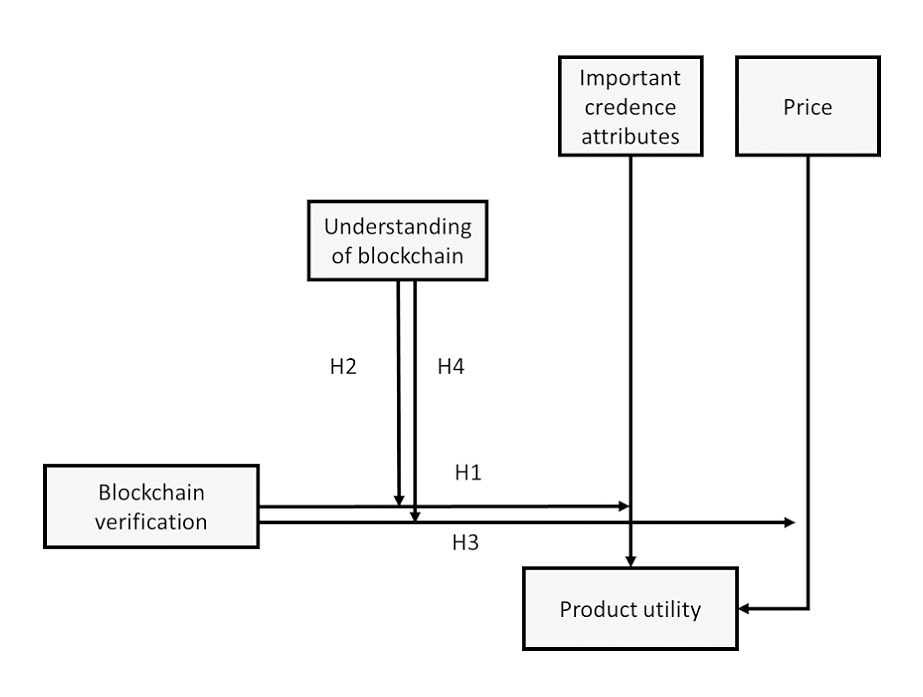 Figure 1. Blockchain verification and use of credence characteristics.
The study is based on an online choice experiment carried out in six European countries.
Sample and Data CollectionThe sample was collected by the market research agency Norstat (https://norstat.dk/). The target was to collect data in Denmark, Germany, Italy, Poland, Spain and the Netherlands from representative samples of 500 consumers each. The samples were representative in terms of the national level of formal education, age and gender, resulting in an overall sample of 3028 European consumers. Respondents had to eat at least pork or chicken, and respondents who did not normally eat both types of meat answered only that part of the questionnaire that pertained to the meat they eat.
Demographic information of the sample can be seen in Table 1. The first author university’s Research Ethics Committee granted ethical approval with the ID BSS-2022-046. Participants provided informed consent before starting the survey. The study is part of a bigger project and details can be found in [20].
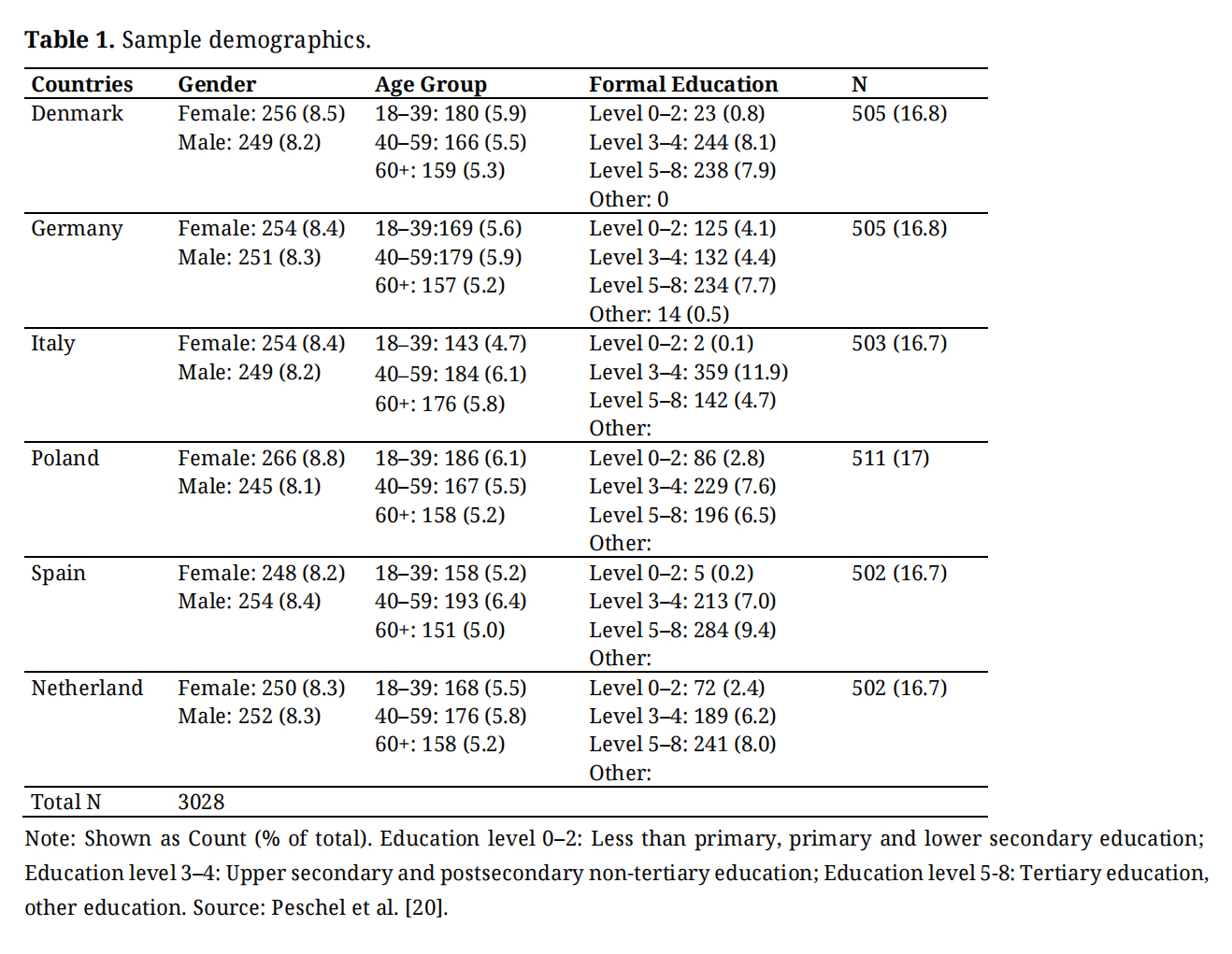 Table 1. Sample demographics.
We conduct a discrete choice experiment for two products, chicken breasts and pork chops. In addition, we introduce the presence of blockchain certification (with/without blockchain certification) as a between subjects factor. Choice modelling is applied to elicit preferences based on the assumptions of random utility theory [21,22].
Participants in our study made choices between two pork chops or chicken breast alternatives (3 pieces, 600 g). They were instructed to imagine making a choice in their regular supermarket. They could opt out of choice through a ‘none-of-these’ alternative. Each participant made 9 choices per meat category in a randomized order. Those participants who indicated that they only consumed pork or only broiler meat in their everyday life received only choice sets for this meat product category. The experimental design of the choice sets was generated as a D-optimal random parameter panel design using Ngene software [23]. The experimental design consisted of 36 choice sets (For chicken, only 35 different choice sets were used due to an error during survey set-up.) with four blocks. The D-error of the final design was 0.26. The attribute levels were combined differently across the choice alternatives based on the experimental design. The list of attributes and levels is displayed in Table 1. Attribute selection was based on a literature review and expert interviews following standard procedures in the field to account for the most important aspects in consumers’ decision-making process [24,25]. The attributes used were sensory properties, feed origin, breed, space allocation, outdoor access and price (see Table 2). Feed origin, breed, space allocation and outdoor access are all credence attributes.
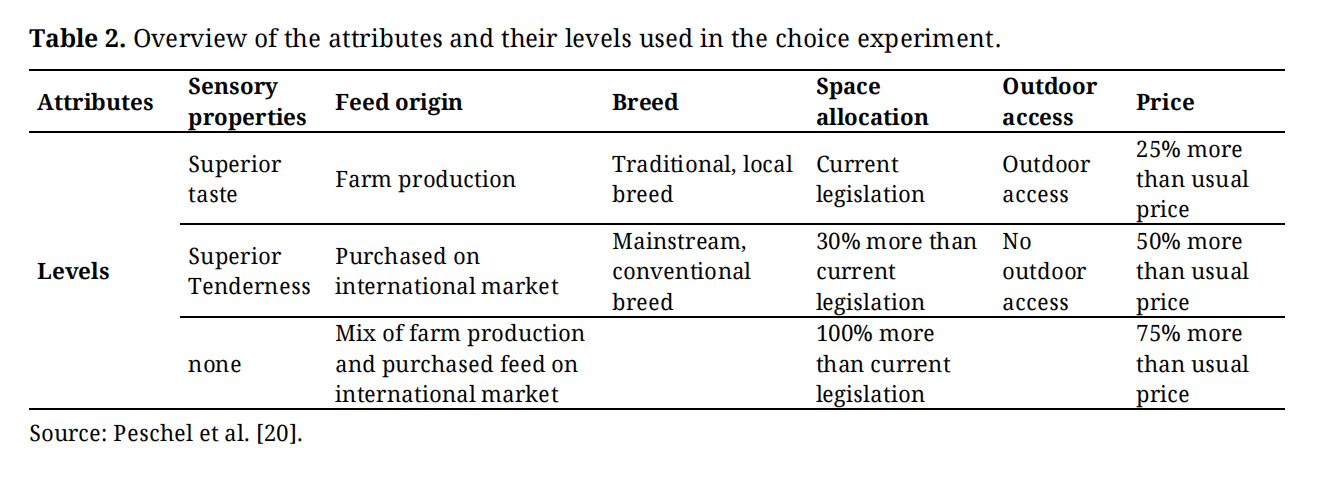 Table 2. Overview of the attributes and their levels used in the choice experiment.
To enhance realism of the choice task and reduce hypothetical bias, we compute the price levels to be displayed for each participant based on their self-reported reference price [26,27]. To enhance compliance with the task, we added a cheap talk script to the introduction of the choice experiment [28]. This was found to be especially important when studying sustainability attributes to reduce social desirability bias [29].
Examples of choice sets for each meat type are shown in Figure 2. Participants in the blockchain condition received information about blockchain technology prior to the experiment (see Appendix A) and an additional claim stating: “Please note that all of these features are verified and can be traced by blockchain technology.” Participants in the no blockchain condition did not get this information and did not see this claim.
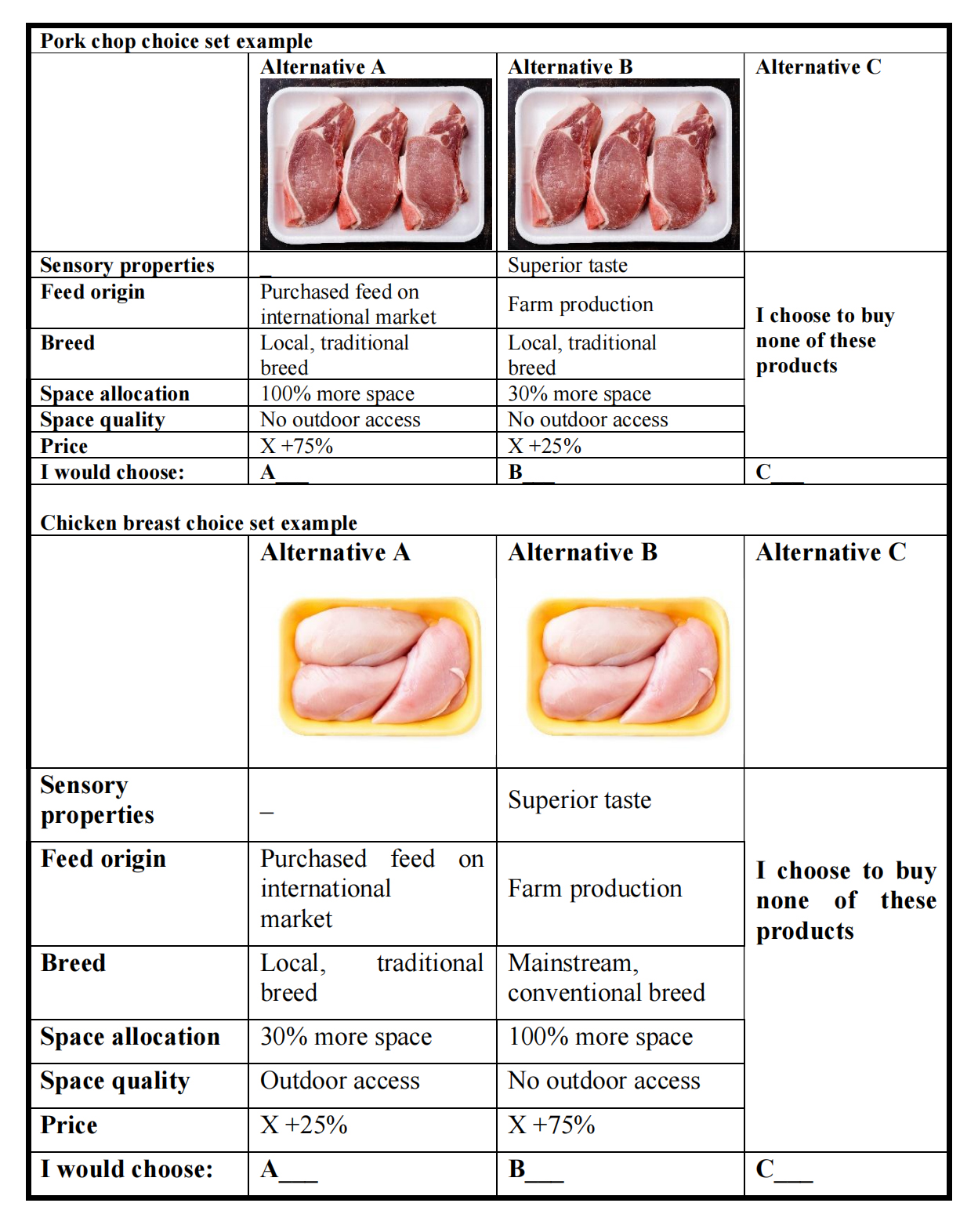 Figure 2. Examples choice sets for both product categories. Note. Participants were instructed to imagine they were purchasing the pork chops/chicken breast that they usually buy in a store. They could choose Alternative A, B or C. Source: Peschel et al. [20].
Understanding of blockchain technology was measured by five items based on the consumer understanding model by Stancu, et al. [30], on a 7-point scale ranging from 1 = does not reflect at all, to 7 = reflects very well, (α = 0.91). The items were crafted in collaboration with an expert in the field and can be found in the Appendix B.
AnalysisFor the analysis, we ran several multinomial logit models in Latent Gold 6.0 [31,32] with two known classes corresponding to the experimental groups with and without blockchain verification. This approach allows us to compare differences in utility between experimental groups in one choice model instead of estimating two separate multinomial logit models in alignment with H1 and H3. Effects coding was used for all variables except price. Price entered the model as continuous variable. Initially, we specified the model with multiple levels, allowing for variation across countries. Since standard model fit criteria (BIC, AIC) did not improve with multiple country levels, we opt for the simpler approach and model the data at the aggregate country level. Running models separately per country also did not change the pattern of results. Similarly, we explored models that account for demographics, such as age and gender, but these did not have an effect in terms of whether blockchain information was provided or not.
The five items of the measure for understanding blockchain were combined into a mean score. To account for the effect of understanding on consumer preferences (H2 and H4), we added understanding as a simple interaction term with the utilities of the credence attributes (feed, breed, space and outdoor) and price for the subsample that was in the blockchain condition. This allows an estimation of the change in utility when understanding increases [33,34]. The understanding variable was mean-centered prior to analysis to ensure interpretability [34,35]. A significant interaction implies that the utility of the attribute changes as the level of understanding changes; for presentation, we choose to present results for utilities at one standard deviation above and below the mean of the understanding score.
For those product attributes where there was no significant difference between the two experimental groups, utility parameters were set to be equal for the two groups. Similarly, interaction terms that were not significant were dropped and the model was re-estimated. This resulted in a model with group-specific utility parameters and interaction effects for outdoor access and price. The remaining credence attribute effects were estimated uniform across groups and without interaction effects. We exclude participants who always opted out of choice (choosing Alternative C in all choices). These were 6.6% for pork and 6.7% for chicken.
Understanding did not differ significantly between experimental groups. For both groups, the mean for understanding was around the mid-point of the scale (Mclaim = 4.53, SDclaim = 1.02; Mclaim = 4.47, SDclaim = 1.06).
Analysis of Choice DataThe relative importance of the attributes is displayed in Table 3. Relative attribute importance is calculated as the ratio of the maximum utility difference of the attribute relative to the sum of the maximum utility differences of the included attributes [32,36]. This transformation of the utility scores reflects the weight that the attribute receives in the decision-making process. It is merely a transformation of coefficients, but not a structural test of significant differences between decision weights.
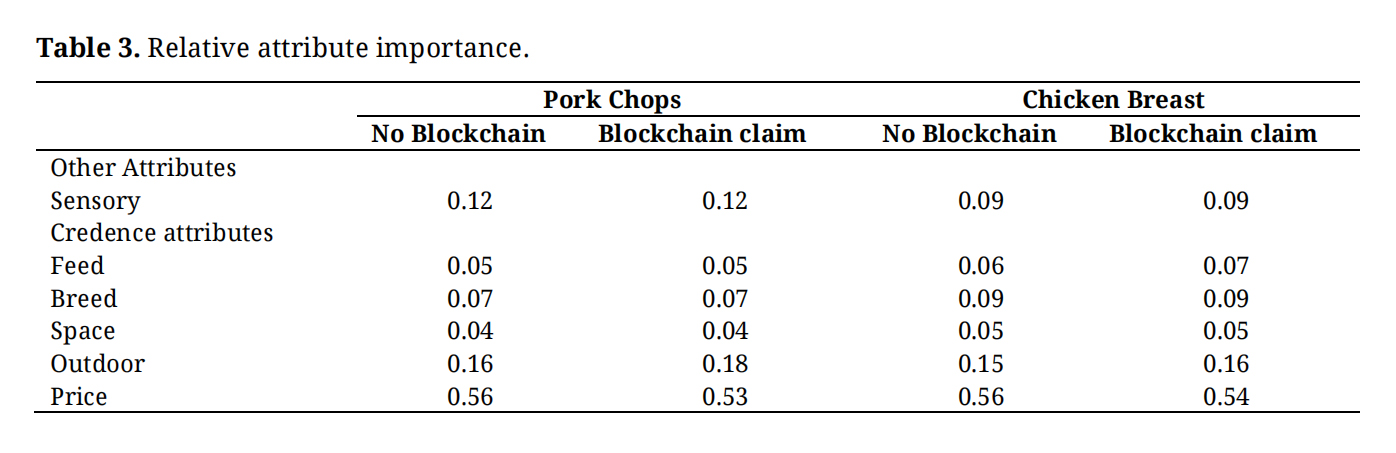 Table 3. Relative attribute importance.
From Table 3 we can conclude that price is relatively less important in the decision-making process when blockchain verification is communicated to consumers. Instead, the outdoor access attribute gains in importance for both meat types. This is also the most important of the credence attributes.
The utilities for the different attributes (except price, where utilities were assumed to be linear with the price premium) are displayed in Figure 3. For transparency, the utilities are also shown in the Appendix C. The figure shows the part worth utilities for the different attributes and their levels. In addition, it shows the differences in part worth utilities according to different levels of blockchain understanding for the attribute outdoor access, which was the most important credence attribute for consumers and the one where the information about blockchain verification and the level of blockchain understanding led to significant differences. Part worth utilities are shown for the mean level of blockchain understanding and for one SD above and below the man (high and low levels of understanding) and for the no-blockchain condition.
Significant differences between the two experimental groups were found for the attribute outdoor access, which also is the most important of the credence attributes for the participants. For both pork chops and chicken breast, the interaction of blockchain understanding and utility of outdoor access was highly significant (Wald = 58.32, p < 0.001 for pork chops, Wald = 45.32, p < 0.001 for chicken breasts), such that the part worth utility for outdoor access was higher when the information was blockchain verified and when blockchain understanding was high. For pork chops, the main effect of blockchain verification was also significant (Wald = 5.19, p = 0.02), while it was not significant for chicken breasts (Wald = 0.89, p = 0.34). These results confirm H2 and partly H1.
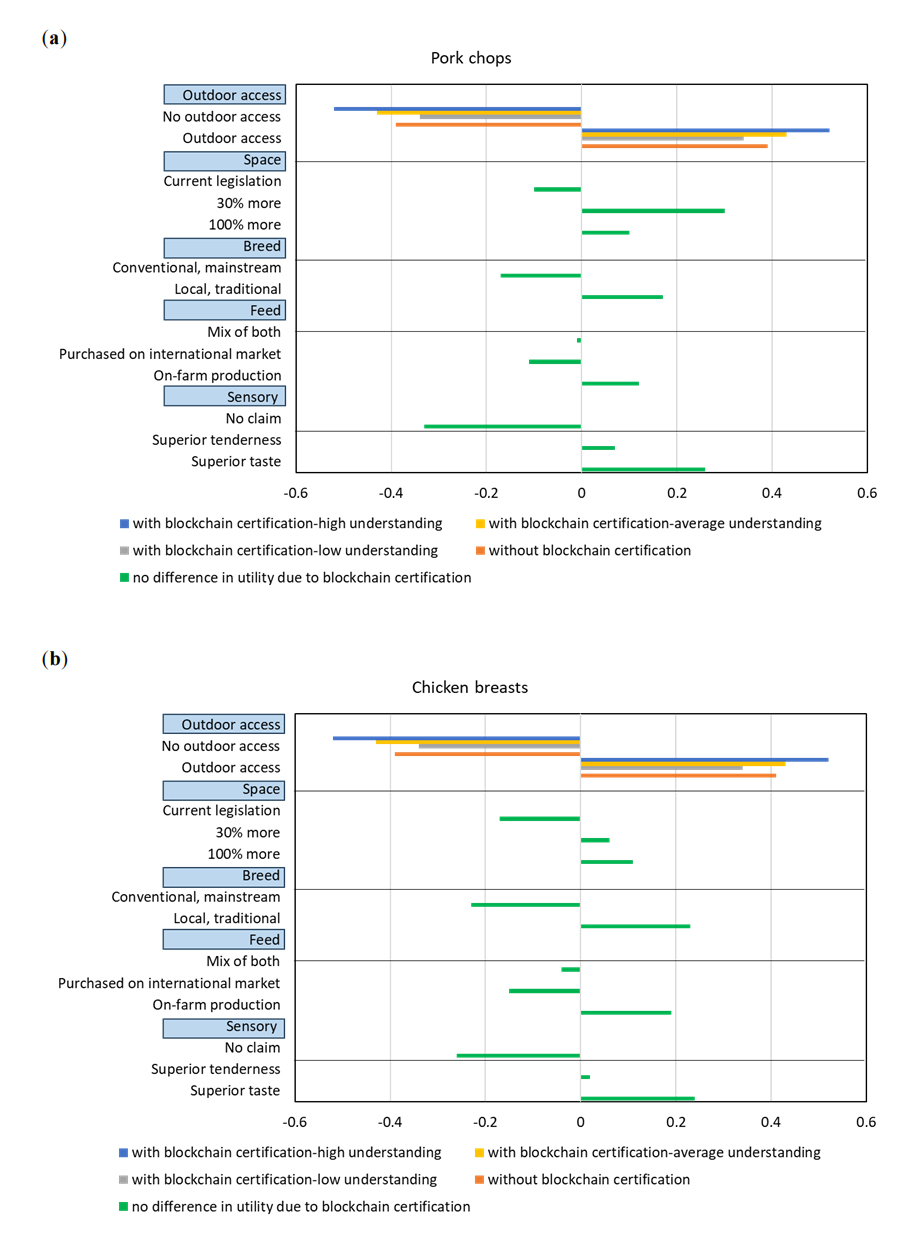 Figure 3. (a) Product attribute utilities with and without blockchain certification for pork chops and (b) chicken breasts. High and low levels of understanding are indicated for one standard deviation below and above the average.
The results for the price attribute can be seen in Figure 4. Also here, the interaction of blockchain verification and blockchain understanding is significant for both products (Wald = 10.04, p = 0.001 for pork chops, Wald = 17.66, p < 0.001 for chicken breasts), such that the disutility of price is higher when no blockchain certification is present, confirming H4. The main effects of blockchain verification were not significant (for pork chops Wald = 3.22, p = 0.07; for chicken breasts Wald = 2.11, p = 0.15). As can be seen in Figure 4, the blockchain certification decreases the disutility of the price differentials, and this effect was smaller for higher levels of understanding of blockchain. As can be seen, the price disutility at the highest level of blockchain understanding is almost identical with the non-blockchain condition.
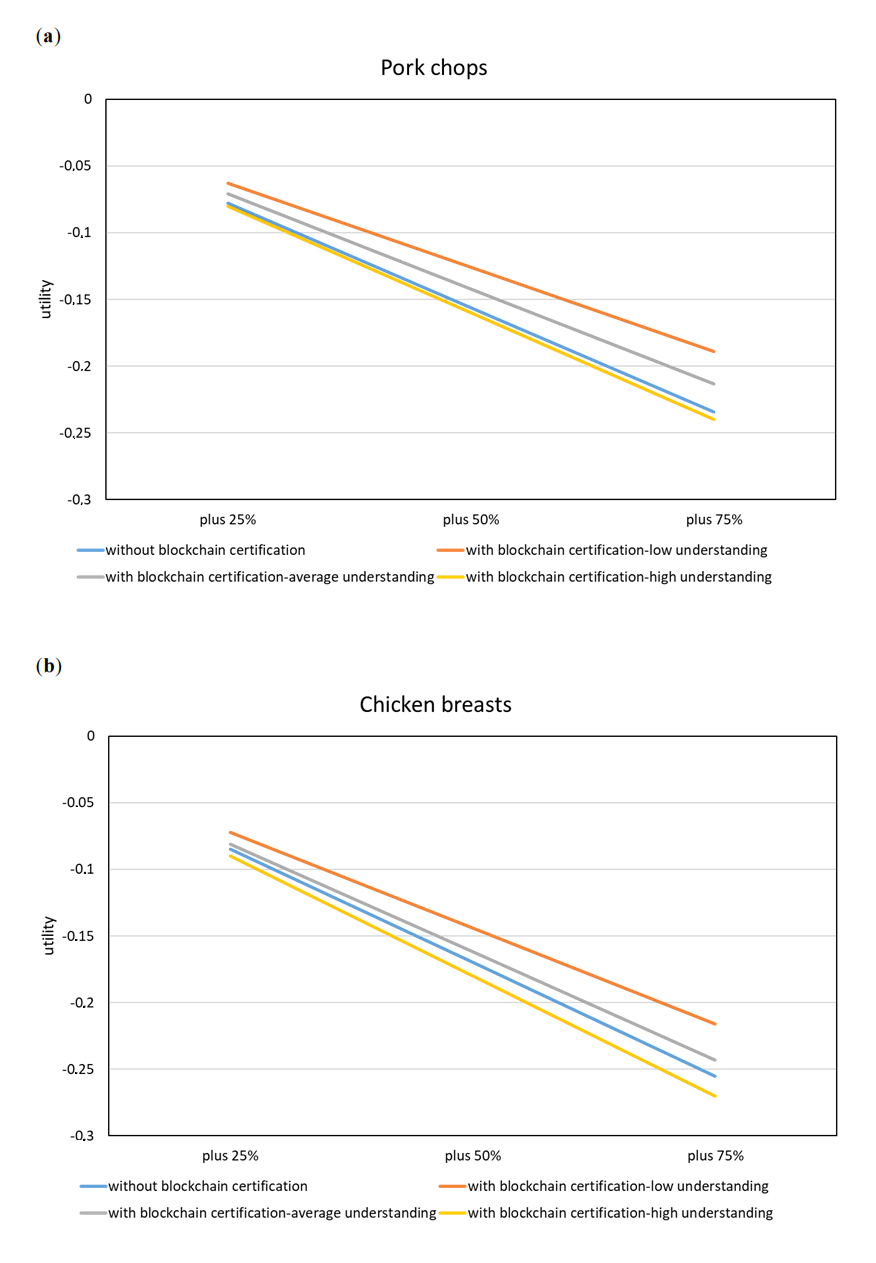 Figure 4. (a) Price disutilities with and without blockchain certification for pork chops and (b) pork chops. High and low levels of understanding are indicated for one standard deviation below and above the average.
We investigate how blockchain verification affects consumer decision-making for pork chops and chicken breasts, two products that are increasingly marketed based on credence characteristics related to animal welfare and sustainability. When or to the extent that these attributes are important for consumers, the information that the information is blockchain verified can increase consumer confidence in this information such that it plays a bigger role in decision-making. While this presupposes some reasoned approach to decision-making, it is known that labelling information also can affect consumer decision-making in a more peripheral way. If the information that blockchain certification has been applied is processed in a peripheral way, this can increase consumer value perception even when the valuation of the product attributes remains unchanged. In our study we found some evidence on both of these effects. The attribute outdoor access, the for participants most important of the credence attributes, is assigned more utility in the decision by consumers when the information is claimed to be blockchain certified, and this effect is dependent on consumer understanding of the concept of blockchain such that the utility of outdoor access becomes higher the higher the understanding. The disutility of a price differential compared to standard product becomes smaller when the product is labelled as blockchain certified, and this effect becomes smaller with increasing understanding of the concept of blockchain—indicating that a higher understanding of blockchain makes peripheral processing less likely.
This double effect of blockchain certification may help to understand previous results on consumer willingness to pay for blockchain certification. For example, Shew, et al. [14] found willingness-to-pay premiums higher for accredited label certification than for blockchain verification, whereas Lin, et al. [37] found willingness-to-pay to differ across consumer segments.
While it has been previously argued that if a labelling concept is not understood by consumers, it will not create value for them [38], the proposition that labelling information can be processed peripherally suggests that this may not be universally true, and our results support this. Factual knowledge on blockchain is relevant to influence utility, as this knowledge can lead consumer to have more confidence in attribute information that is blockchain certified. On the other hand, a lack of knowledge can result in that consumers attach some diffuse added value to the information about the use of blockchain certification, in the same way as the pure presence of a nutrition or sustainability label can add value in the consumer mind, irrespectively of the information that label actually provides. A separate value creating effect of blockchain certification, independent of credence attributes, has been shown before by Contini, et al. [13], but they did not control for level of understanding. That a label on handling of information in the value chain can be processed peripherally has likewise been shown before [19], although not in the context of blockchain.
The role of understanding has so far been overlooked in the discussion about blockchain technology. Our results show that if blockchain is to be used to increase transparency for consumers and support informed consumer choice, understanding is a prerequisite. A lack of understanding can result not only in information on credence attributes still being discounted, but also in the perception of some added value that is unrelated to the product characteristics.
Limitations and Future ResearchWe acknowledge that our study faces some limitations, which should be addressed by future research. We acknowledge that we only compare blockchain verification in two meat value chains. Future research on different product value chains will broaden the scope of results. The effect of blockchain certification may well differ according to the type of credence attributes that are important for consumers for a particular product category. Also, product categories differ in the availabililty of alternative ways in which consumer confidence in information about credence attributes can be provided. Fresh meat is mostly an unbranded product, but for product categories where strong brands exist the brand is an alternative way of creating consumer confidence in the attribute information provided. While we did not find that the effect of the blockchain certification was dependent on the country in our six-country study, it is clear that food consumption is affected by cultural differences and how these affect the role of attempts to increase value chain transparency is an important topic for future research. In addition, different presentation modes of blockchain information could be investigated to identify their effect on enhancing consumer understanding [39].
Managerial and Policy ImplicationsOur results suggest that telling consumers that product information has been blockchain verified can affect their decision-making both under high and low levels of consumer understanding of what blockchain is all about, but that they mechanisms by which this happens differ. Under low levels of understanding, consumers may perceive some unspecific added value that decreases the disutility of a higher price, but does not change the utility of specific product attributes. We suggest that this is due to peripheral processing. Under high levels of understanding, consumers attach more utility to the credence attribute that is most important for them.
From a managerial perspective, one could therefore argue that blockchain verification is always good, even when consumers do not understand what this means. From a policy perspective, however, when the policy aim is to support more sustainable consumer choice, good understanding of the blockchain concept is a prerequisite that must be met if the technology indeed is to help consumers making informed choices. This calls for education campaigns on the functionality as well as the benefits of blockchain verification to increase objective understanding of the concept, when implementing blockchain verification and to apply it to relevant attributes. Still, we would like to argue that achieving a higher level of understanding of the blockchain concept by consumers is desirable also from a managerial perspective. Investing in blockchain verification is linked to positioning products in terms of credence attributes, and any potential competitive advantage resulting from his is dependent on that the effect of the blockchain verification is indeed linked to those attributes. Our study indicates that blockchain certification can indeed support consumers’ use of credence attributes in decision-making and thus help in the use of credence attributes for market positioning, but that these effects depend on assuring a satisfactory level of the consumer of blockchain by consumers.
We would now like to inform you about blockchain technology:
Pork and chicken are commonly consumed food products in Denmark The food product originates at a farm, is moved to slaughtering and processing, and finally to a retailer—that means it is handled by several actors before ending with the consumer. If consumers are interested in the way the pork or chicken has been produced—for example, with regard to the sustainability or the animal welfare of the production process—this information has to travel from one actor to the next, a process that is prone to error and even fraud. By using blockchain technology, one can make sure that information is always accurate.
Blockchain technology can be used as a digital decentralized bookkeeping system, which is based on advanced algorithms and computer power. Imagine an excel datasheet with credit and debit in two columns, this is called a ledger. In a blockchain system, information in a ledger can only be added, never changed, deleted, or manipulated with. Everyone in the supply chain has a copy of this ledger, which means everyone has documentation for what has happened. In this way, the information in the blockchain is decentralized and there exists a “shared-truth” of what has happened. When the meat moves a step in the supply chain, the user with the right evidence or proof can add this information to the ledger and the ledger is then updated. Everyone in the chain gets an update that it has gone from A to B and C, and everyone with the ledger then shares the information that this has occurred. Through what is known as cryptography, data and information through the chain can be 100% trusted as it cannot be manipulated.
Blockchain is simply a chain of blocks with information. A block contains 3 things. One: the information, an example could be “this is organic pork/chicken”, two: a hash code, which is a unique digital fingerprint in the form of a randomly generated piece of code, and three: the hash code from the previous block, which is what binds the blocks together. If the information in the block is changed, the hash will change as well, and every actor involved gets notified. This means that if a supplier tries to declare conventional pork or chicken as organic pork or chicken, thereby tampering with the information in a block, the hash of the block will change and now no longer fits the next block, making the chain invalid. This is what makes blockchain transparent, trackable, and immutable.
What makes blockchain so valuable for you, is that a product can be equipped with a QR code that can be scanned and gives you access to view all of this data. This enables you to track every step of how the pork or chicken were produced and how they were shipped. This ensures creditable transparency so that you can trust the information that comes with a product before you buy it.
●
●
●
●
●
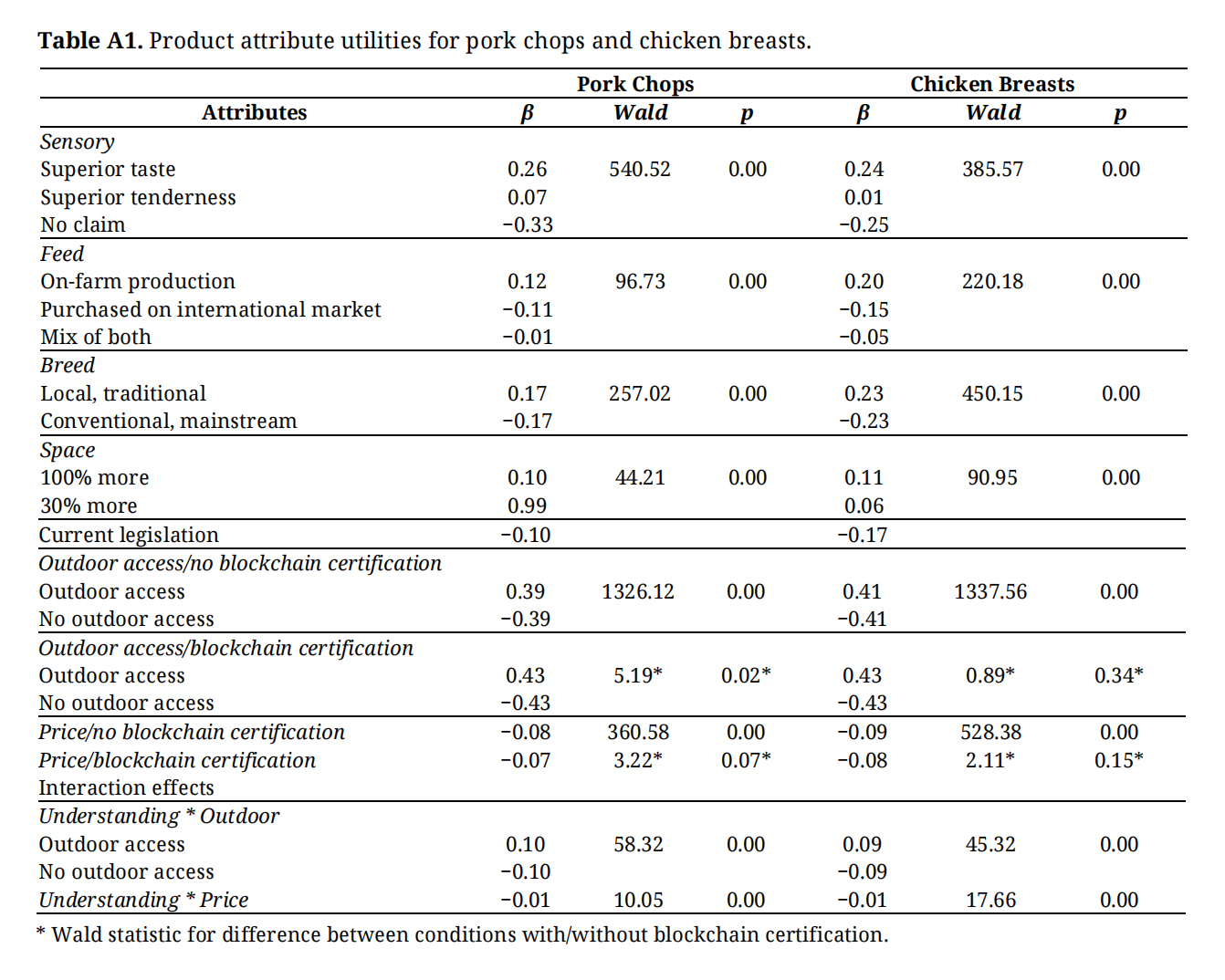 Table A1. Product attribute utilities for pork chops and chicken breasts.
Data can be made available upon request.
Conceptualization, AOP and KGG.; methodology, AOP and KGG; formal analysis, AOP, KGG and GT; investigation, AOP; data curation, AOP, GT; writing—original draft preparation, AOP; writing—review and editing, AOP, KGG and GT; supervision, KGG; funding acquisition. All authors have read and agreed to the published version of the manuscript.
The authors declare not conflict of interest.
This research was made possible by the project “mEATquality-Linking extensive husbandry factors to the intrinsic quality of pork and broiler meat” funded by the European Union’s Horizon 2020 research and innovation programme (Grant Agreement No 101000344).
1.
2.
3.
4.

Copyright © Hapres Co., Ltd. Privacy Policy | Terms and Conditions


