Location: Home >> Detail
J Sustain Res. 2026;8(1):e260014. https://doi.org/10.20900/jsr20260014

1 Material Cycles Division, National Institute for Environmental Studies, 16-2 Onogawa, Tsukuba City, Ibaraki 305-8506, Japan
2 Department of Environment Systems, Graduate School of Frontier Sciences, The University of Tokyo, Kashiwa-no-ha, Kashiwa City, Chiba 277-8563, Japan
The concept of living with fewer material things has gained increasing public attention, and “tidying up” has been popularized through the work of Marie Kondo in books and mass media. However, previous research on how tidying influences consumption behavior remains limited. This study draws on semi-structured interviews with 15 professional tidying consultants in Japan to examine how tidying relates to consumption practices and environmental attitudes. Most respondents were middle-aged women who had been full-time homemakers. They described long-standing difficulties in managing household possessions and reported turning to tidying to reorganize their lives. After tidying, they all began to practice a less material-intensive lifestyle by not keeping unnecessary stocks and by using things that they already had. They also did regular maintenance on their existing items and tried to use things for longer periods of time. However, the links between tidying and broader environmentally friendly behaviors and attitudes, such as saving energy or reusing secondhand goods, were weak and depended mostly on personal values. Overall, the findings suggest that tidying may be linked to mindful consumption, but it does not necessarily lead to substantial changes toward sustainable consumption.
As more and more consumer goods are being mass produced, the range of goods that consumers can afford has expanded. The term “consumer society” has been widely used around the world since the 1980s [1], because we now live in a society where people, including ordinary citizens, engage in high-level consumption. High-level consumption means living a life of affluence that not only maintains health and safety but reaches a level that makes a certain degree of convenience, enjoyment, and luxury possible. American economic psychologist George Katona defines a consumer society as a mass consumption society [2]. The establishment of a mass consumption society depends on factors such as rising incomes and the development of mass media [3,4]. Companies spend a great deal of money on marketing every year to instill their brand values in the minds of consumers. Repeated exposure to advertisements through TV, newspapers, and internet reinforces brand recognition. For some people, consumption has become a way of life or a means of maintaining their identity. To induce impulse buying by consumers, various approaches are used in marketing [5,6]. By using messages such as “limited,” “only a few left,” and “limited time offer,” consumers are encouraged to feel that “they will regret it if they don't buy now”. By stimulating consumers’ emotions (e.g., happiness, anxiety, and nostalgia), retailers encourage impulse buying [7–10].
As people have become more affluent, the negative aspects of a consumer society (e.g., pollution, waste, and resource issues) have become more apparent [11–13]. In this context, anti-consumerism (or anti-consumption movements) such as voluntary simplicity movements have spread, and interest in “post-materialism” has increased. Against this social background, environmentally conscious consumerism (“green consumerism”) has emerged [14]. In particular, the Brundtland Report, Our Common Future, popularized the concept of “sustainable development” and prompted a change in consumer awareness [15]. In addition, in 1989, The Green Consumer Guide was published in the UK, and environmentally friendly consumer behavior began to attract widespread attention [16].
It is said that a prosperous society began to be established in Japan in the mid-1950s to the 1960s [17]. Television broadcasting began in 1953 and represented a mass advertising medium that stimulated consumption. Owning durable consumer goods such as cars, air conditioners, and color TVs was considered a status symbol in the 50s–60s. American photojournalist Peter Menzel visited average homes in 30 countries worldwide and photographed families with all their possessions in front of their homes in early 1990s [18]. The Japanese photo in this book was of an average middle-class Japanese family of four who owned many things, including household appliances, furniture, books, clothes, and other items. During the bubble economy in Japan from the late 1980s to the early 1990s, owning expensive things or luxury brands became a status symbol. Even after the bubble economy burst in the late 1990s, consumerism continued. In Japan, being good at holding on to things was considered a virtue, and many people felt confused or guilty about throwing things away. As a result, many consumers also began to face the problems of managing their possessions. Time and effort were needed to care for the various items they now owned (e.g., cleaning, organizing, storing, and maintaining them), and discarding things requires time and expense.
Many books on decluttering have become best sellers since the late 1990s [19–25]. These methodologies were not just about organizing but also functioned as a process of self-realization. Various specialists and organizing advisors have developed their own methods, and there are at least 10 different popular organizing methods in Japan. Each method has its own philosophy and methods, and people can choose the one that suits their own personal lifestyle and values. Internationally, Marie Kondo’s method was published in the US in the 2010s as The Magic of Tidying Up and became a worldwide phenomenon. In Europe and the US, it was well received owing to its affinity with the minimalism movement and other unique tidying philosophies from various countries.
Some limited research on clutter in non-clinical populations has found strong relationships between clutter and stress, shame, and subjective well-being [26–29]. Belk et al. conducted an ethnographic investigation of professional organizers in US [30]. Belk explored how professional organizers implement their method to help clients address clutter and disorganization in their homes. Pantofaru et al. interviewed 12 working adults (ages 27 to 60) in the US to determine their home organization strategies, processes, and difficulties [31]. This study explored organization realities in homes to develop frameworks and design implications for potential home robotics applications. Smarr et al. conducted questionnaires and semi-structured interviews with 20 younger and older adults in the US to investigate their needs and the factors impacting home organization [32]. There were no clear trends for the most and least organized rooms and storage spaces in both age groups. However, there were trends for facilitators of (e.g., fewer items in room, places for everything) and barriers to organization (e.g., many items in room, no plan for organizing). Chamberlin and Callmer studied KonMari practitioners in Sweden, UK and Ireland (12 interviewees in each country), finding that participants reported significant shifts in their consumption approach after adopting the method, particularly becoming more reflective and restrained when acquiring new items [33]. Lee conducted in-depth interview with 11 female adults (ages 26–47) examined how consumers declutter link to their happiness in the decluttering process of the KonMari method [34]. Lee suggested that tidying up can lead to a sense of happiness by making a sudden shock into the object-subject relation, and by making tidying up a meaningful task rather than just a household chore.
There have been a few studies on decluttering (“tidying up”) and its impact on changes in consumption (e.g., [33,34]), but no studies have been done in the Asian region. To my knowledge, no study has examined the relationship between tidying up and green consumerism, as well as environmental behavior. Recently, the sharing economy has gained attention as it attempts to promote more efficient resource use by reducing the need for ownership. In the context, it is essential to explore lifestyle shifts towards the sharing economy, but research in this area remains limited.
In this study, I conducted qualitative interviews with professional tidying consultants in Japan, asking why they were interested in tidying and how they kept things tidy. The reason for choosing tidying consultants is because identifying people who have succeeded in tidying is difficult. Like dieting, people who attempt to become tidy are not always successful, and many, if not most, people give up along the way [34]. For this reason, I chose to survey consultants in the context of people who have succeeded. Parental involvement plays a substantial role in the development of young children's organizational skills and behaviors [35]. Therefore, it was important to consider the consultants’ childhood experiences to understand their skills and abilities as well as their reasons for tidying. I also asked how their behaviors and their perceptions about consumption had changed after they had completely removed clutter and organized their homes, and looked at the relationships among tidying, consumption, and environmental awareness.
Specifically, this study sought to answer the following three questions: (1) What made people tidy up? (2) Why are some people able to keep things tidy? (3) How does tidying up transform people’s values about things and consumption patterns? The objective of this study was to explore how tidying influences consumption patterns.
Because this study examines tidying as a practice linking psychology, consumption, and sustainability. I review literature on clutter and well-being, barriers to decluttering, the effects of decluttering, and connections to mindful consumption.
The accumulation of possessions is influenced by multiple psychological and behavioral factors. The continuous release of new products and consumers’ desire to acquire them contribute to excessive material accumulation. High stress levels drive shopping as a coping mechanism, while busy lifestyles limit decision-making time, leading to delayed choices regarding item disposal. Psychological barriers, such as guilt over discarding items and uncertainty about future needs, further reinforce hoarding tendencies [36,37]. Even individuals who are not predisposed to hoarding may accumulate excessive possessions because of inattentive consumption and distractions from work or daily life.
Clutter and Well-BeingSeveral studies have indicated a strong relationship between clutter and mental health. Excessive possessions and disorganization are linked to feelings of anxiety and depression [28,38,39]. Cluttered environments contribute to increased stress [29] and decreased productivity [40].
Psychological Barriers to DeclutteringSeveral cognitive and emotional factors contribute to resistance in discarding possessions. Emotional attachment to belongings fosters reluctance to part with them [41–43]. Additionally, decision avoidance, perfectionism, and indecisiveness further prevent individuals from decluttering [20,24,25]. Animistic beliefs about objects, where individuals attribute human-like qualities to possessions, can also impede disposal [44].
However, one of the major reasons for not being able to throw things away is that we are unconsciously bound by “sunk costs”—that is, the cost of having spent money on something in the past, even though it may have little or no value now. In addition, once people own things, they become bound by the “ownership effect,” which causes them to overestimate the disadvantages of letting go of something.
Effects of DeclutteringDecluttering has been identified as an effective intervention for improving mental and emotional well-being. Studies suggest that motivation to clean—driven by desires for emotional refreshment, comfort, and hygiene—leads to voluntary decluttering and improved psychological health [45]. The benefits of decluttering include increased self-esteem and quality of life [46], improved sleep [47,48], and reduced stress [34]. Furthermore, organizing one’s environment has positive effects on interpersonal relationships [29].
Tidying and Mindful ConsumptionDecluttering may foster mindful consumption. The KonMari method of ritualized sorting (i.e., answering the question, “what sparks joy?”) leads to more reflective purchasing, reduced shopping, and reinterpretation of the meaning of possessions [33]. Decluttering serves as a “window of opportunity” where reconsidering possessions triggers sustainable consumption patterns [49]. Minimalists similarly practice intentional (non)consumption—buying less and making ethical, considered purchases [50–52].
While existing research has examined tidying's effects on well-being, happiness, and mindful consumption [53], its relationship to sufficiency and broader environmental behavior remains underexplored. In particular, how tidying behavior transforms consumption through efficiency and comfort-seeking has not been theoretically evaluated. This gap motivates the present study, which empirically examines how tidying reshapes consumption practices and whether such changes translate into environmentally friendly behavior.
I conducted semi-structured interviews in Japan between October 2018 and February 2020. I selected people of various ages who lived in different areas of Japan. Twelve interviewees were selected from a list of relevant associations’ consultants, two participants were recommended by the associations, and one was suggested by another interviewee, for a total of 15. The interviews continued until the point of theoretical saturation was reached, defined as the stage at which no substantively new codes or themes emerged from successive interviews [54]. During the later stages of analysis, additional interviews were conducted, but they primarily reinforced existing categories rather than extending or modifying the analytical framework. Nine interviews were conducted face-to-face in conference rooms and coffee shops, and six interviews were conducted in the respondents’ houses. The interviews were conducted in accordance with the Code of Ethics of the Japan Association for Social Research.
Table 1 outlines the interview flow. Each interview was divided into three phases: current life, life to date, and future life and society. Each respondent was asked to prepare a life timeline (in Excel or Word format) in advance to outline the chronological order of their significant life experiences. Each interview lasted 1 to 2 hours. All interviews were recorded and transcribed. Transcriptions were qualitatively coded and analyzed with MAXQDA Plus 2020 software [55]. Through iterative coding, themes related to possession reduction, consumption rules, and sustainability-related attitudes were identified and organized into analytical categories.
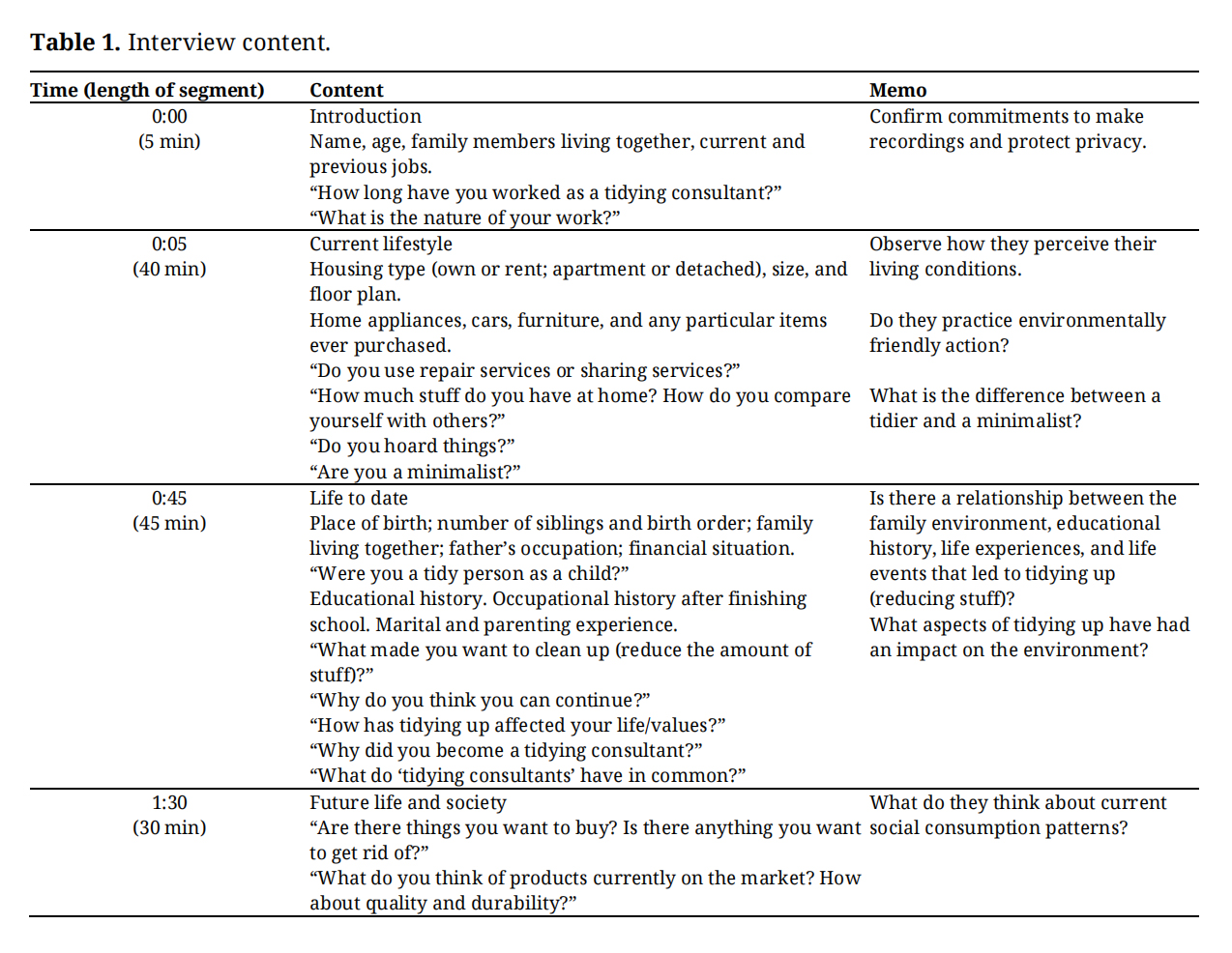 Table 1. Interview content.
The respondents were predominantly middle-aged women in Japan who became professional tidying consultants after experiences as full-time homemakers (Table 2). Most lived in owner-occupied housing and identified as middle-class, reflecting their relatively stable living conditions. Two male respondents also became consultants, either as a side occupation or following a job loss.
Childhood experiences with tidying varied. Approximately half of the respondents considered themselves poor at tidying during childhood, often attributing this to disorganized parental households. However, no clear relationship was observed between childhood tidying habits and later tidying competence because most respondents owned few personal belongings while growing up.
Pathways to tidying were typically triggered by life events such as marriage, childbirth, job changes, housing renovations, or external shocks such as natural disasters. These events often coincided with periods of stress, shopping as a coping mechanism, and the accumulation of possessions. Across cases, tidying emerged as a means of regaining control, restoring comfort, and initiating personal change.
These backgrounds contextualize the findings below by showing that tidying was primarily motivated by personal life management rather than environmental concern.
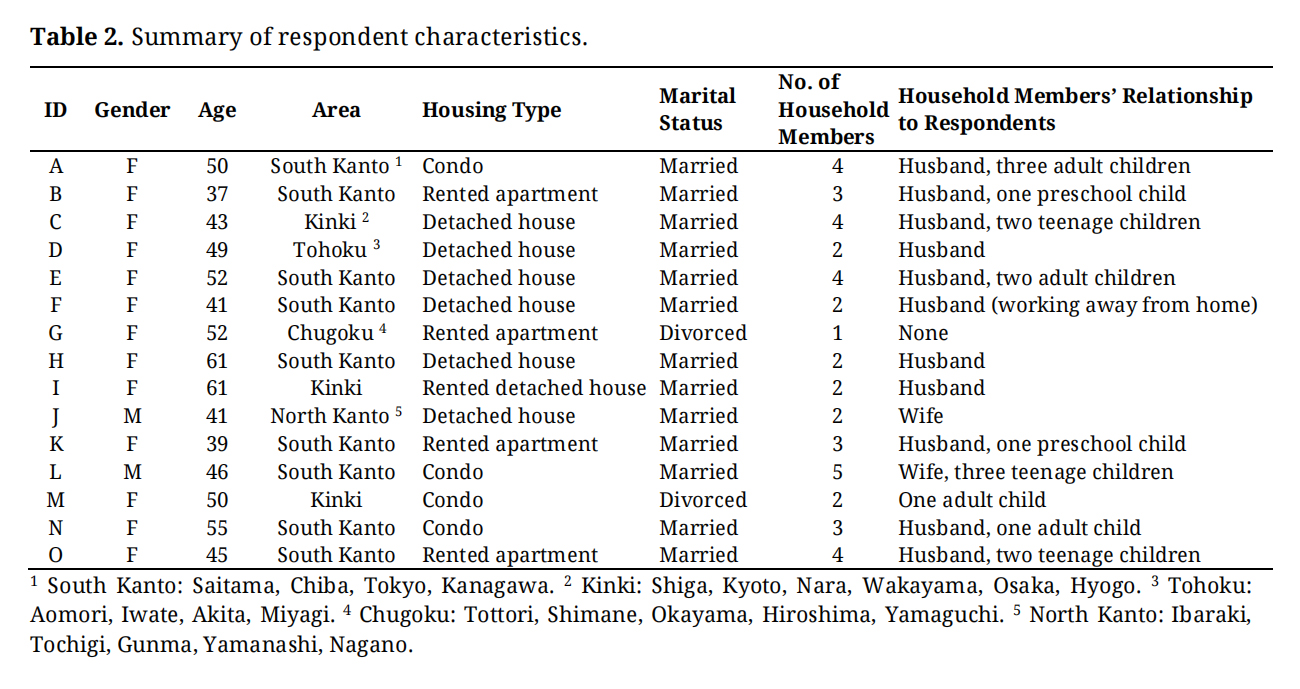 Table 2. Summary of respondent characteristics.
Respondents reported substantial reductions in the volume of their possessions, often estimating that they had reduced their possessions by one-half to two-thirds. Items such as books, clothing, dishes, cooking appliances, tools for hobbies (e.g., calligraphy, scuba diving), and storage furniture (e.g., chests, drawers, dressers, shelves) were greatly reduced in number. Those items did not fit into the respondents’ current lifestyles or could be substituted with other things.
I think I should count, but my crockery is really down, less than half. (I)
As for clothing, I think I reduced it to about one-fifth [of what it was before]. The same is true for books; I think my books are now about one-tenth of what they were. (J)
Many respondents emphasized that reducing possessions made daily life easier and allowed them to use their time more effectively. In addition to small household items, respondents also reduced the amount of large furniture such as wardrobes, bookcases, and sofas, in part because they had reduced the amount of clothes, books, documents, and dishes. In contrast, most respondents continue to own and use major consumer durables such as refrigerators, air-conditioners, and washing machines, although the answers varied slightly by life stage. Although some respondents described preferences for minimalist aesthetics—such as choosing white-colored appliances—few identified themselves as minimalists. A small number of respondents reported giving up specific household appliances, such as televisions or kitchen appliances, when they perceived them as unnecessary or inconvenient. These substitutions were typically motivated by convenience, space constraints, or changes in family composition rather than environmental considerations.
In contrast, car ownership remained largely unchanged. Only two respondents living in urban areas reported disposing of their cars, while most respondents—particularly those living in suburban or rural areas—continued to rely on private cars, often citing comfort and personal preference.
A car is something to own. I like to drive a car. I drive everywhere. I even drive to work if I can. I think of the car as my living room ... and I want to be comfortable. (N)
These findings indicate that tidying led to substantial reductions in the number of everyday possessions and storage-related goods, but high-impact durable goods remained largely unchanged.
Rule-based control and prevention of re-accumulationAfter tidying, respondents described adopting self-imposed rules to prevent the re-accumulation of possessions. One common strategy was to limit the number of items to a fixed quantity or to the capacity of available storage space. For example, some respondents decided in advance how many items they would keep within a given category, such as clothing or books, and refrained from acquiring more beyond that limit.
I also decided on the number of possessions that “spark joy” in me. So, for example, three pairs of socks [are enough] … I like books, so if I don't keep them in mind, they will increase forever, so I keep as many as can fit in this space. (A)
Another widely reported rule involved managing consumable stocks based on anticipated usage within a given time period. Respondents avoided bulk purchasing and discounted items if these were likely to exceed their storage capacity or management ability. Several respondents explicitly stated that such rules helped them resist impulse buying, even when prices were low, and reduced the likelihood of unnecessary accumulation.
For example, I have decided to stock one packet of detergent. To make sure I don’t take up storage space I buy another one only when I have used up the first. I don't buy things just because they are cheap. In the past, I used to feel like I had to buy something on sale, but now I think it's more about comfort in the house. I also think about how much money is spent on storage space. So, I decided to emphasize people's comfort. (E)
These rule-based practices indicate that post-tidying consumption was primarily oriented toward maintaining household order, manageability, and comfort, rather than toward explicit environmental or sustainability considerations.
Limited environmental spillover in consumption and ownershipAlthough respondents demonstrated heightened awareness of excessive consumption and waste, this awareness did not consistently translate into environmentally friendly consumption practices. Many respondents described contemporary markets as offering products that were convenient, inexpensive, and readily accessible, while simultaneously recognizing that such conditions encouraged overconsumption and future waste.
I think it's great that things have become more convenient … more disposable products that saves time and effort, but it also creates a lot of waste. (D)
Despite this recognition, respondents’ own consumption choices were largely guided by considerations of functionality, comfort, and personal preference rather than environmental performance. For example, respondents emphasized the importance of clothing and household items that suited their bodies, lifestyles, or aesthetic preferences, even when these items were produced by fast fashion brands.
I buy things with good functionality. For example, I'm a cold person, so I can't let go of things like HEATTECH [a UNIQLO brand innerwear]. It's not that I can only buy UNIQLO underwear—I buy it because I like it. Of course, I also wear the outerwear if I like the year's UNIQLO design. (M)
Engagement with alternative consumption models such as sharing and secondhand markets was similarly limited. While most respondents expressed positive attitudes toward the sharing economy in principle, actual participation tended to be confined to specific items such as rental dresses or cars. Many respondents preferred to own everyday items themselves, maintain them over time, and ultimately dispose of them personally.
If you ask me if I do it often, I don't. I choose, use, and maintain things myself. And then, I would say, “Thank you very much,” and throw them out in the garbage. (M)
Moreover, several respondents expressed reluctance toward purchasing secondhand goods, particularly clothing and accessories, citing concerns about the emotional or symbolic “energy” associated with previous owners. This belief further limited the uptake of reuse practices, even among individuals otherwise committed to reducing clutter.
Secondhand items carry the feelings of the previous owner. We are paying money to buy something with negative energy. A new one is less likely to be exposed to such negative energy. (C)
Overall, tidying generated increased reflection on consumption, but it produced limited spillovers into environmentally oriented behaviors, revealing a disconnect between household order, personal comfort, and sustainability-oriented consumption.
This study found limited evidence of substantial lifestyle transformation following tidying. Rather than radically reducing consumption, respondents primarily reduced the number of unnecessary possessions accumulated through prior purchasing. The most salient changes were related to saving time and space, improving manageability, and enhancing everyday comfort. In this sense, tidying reshaped how possessions were managed in daily life rather than fundamentally altering consumption orientations.
While tidying did not lead to a strong orientation toward sufficiency, understood as the deliberate limitation of consumption for environmental reasons, it may have contributed to stabilizing consumption patterns. Respondents described practices such as avoiding overstocking, assigning fixed places for belongings, and resisting impulse purchases. These practices may help suppress rebound effects typically associated with efficiency-oriented interventions [56,57], although the evidence remains limited and indirect.
Importantly, the absence of strong rebound effects does not imply a shift toward sufficiency. Respondents’ consumption was guided primarily by convenience, comfort, and personal preference rather than environmental considerations, and consumption was not necessarily reduced in absolute terms. As Gough emphasizes, sufficiency involves rethinking what is considered “enough” in relation to well-being and material needs, a process not clearly observed in this study [58]. As Jackson argues, sustainability transitions require not only more careful choices but also explicit engagement with consumption limits—an element largely absent from the tidying practices observed in this study [59].
Despite these limitations, tidying practices offer meaningful implications for policy, education, and behavioral interventions. Practices such as purchasing only what is needed, avoiding stockpiling, assigning fixed places for belongings, completing small tasks without delay, and suppressing impulse buying can be incorporated into everyday routines. These habits reduce cognitive load, improve household management, and foster a sense of control and satisfaction, resonating with concepts of mindful consumption and subjective sufficiency even when environmental motivations are not explicit.
Respondents’ preference for new products, emphasis on convenience, attachment to material comfort, and prioritization of time and space efficiency suggest that tidying aligns more closely with weak sustainability (efficiency) than with strong sustainability (sufficiency) [60]. Without explicit engagement with environmental values, decluttering alone risks reinforcing material selectivity and replacement rather than absolute consumption reduction.
In sum, tidying reshapes consumption not by reducing desire for goods, but by reorganizing how goods are managed within everyday life. Its contribution to sustainability lies in fostering mindful and efficient consumption practices rather than in promoting sufficiency-driven reduction. Recognizing this distinction is essential to avoid overestimating the impact of decluttering as a pathway to sustainability transitions.
This study examined how tidying practices influence consumption patterns and environmentally related attitudes through qualitative interviews with professional tidying consultants in Japan. The findings show that tidying did not lead to a substantial lifestyle transformation or strong environmentally friendly behavior. Instead, respondents primarily reduced excessive stocks and reorganized possessions in ways that saved time and space, improved manageability, and enhanced everyday comfort.
While tidying fostered careful and selective consumption practices—such as avoiding overstocking and suppressing impulse buying—these changes aligned more closely with efficiency-oriented adjustments than with sufficiency-driven consumption reduction. Preferences for new products, convenience, and personal comfort limited the extent to which tidying translated into broader sustainability-oriented behaviors.
This study focused on individuals who had successfully engaged in tidying and subsequently became consultants. As a result, the sample was biased toward middle-aged women with relatively similar backgrounds and values, which limits the study’s generalizability. The gendered nature of tidying should also be noted. As tidying consultants in Japan are predominantly women, tidying practices may reflect gendered expectations surrounding home organization and care work, which may shape both motivations and outcomes. Future research should examine more diverse populations, including non-consultants and individuals who attempted but did not succeed in tidying, to better understand variation in outcomes.
Overall, tidying should not be overestimated as a direct pathway to sustainability transitions. Its contribution lies in fostering mindful and efficient consumption practices, while its limitations underscore the need to explicitly address environmental values if sufficiency-oriented change is to be achieved.
The dataset from the study is not available because it contains personally identifiable information derived from qualitative interviews and cannot be shared to protect participant confidentiality.
The author declares that there are no conflicts of interest.
This research was funded by KAKENHI, grant number 20K12293.
The author thanks Tomohiro Tasaki for helping with some of the interviews.
1.
2.
3.
4.
5.
6.
7.
8.
9.
10.
11.
12.
13.
14.
15.
16.
17.
18.
19.
20.
21.
22.
23.
24.
25.
26.
27.
28.
29.
30.
31.
32.
33.
34.
35.
36.
37.
38.
39.
40.
41.
42.
43.
44.
45.
46.
47.
48.
49.
50.
51.
52.
53.
54.
55.
56.
57.
58.
59.
60.
Yoshida A. Does Tidying Up Lead to Environmentally Friendly Consumption? J Sustain Res. 2026;8(1):e260014. https://doi.org/10.20900/jsr20260014.

Copyright © Hapres Co., Ltd. Privacy Policy | Terms and Conditions


